
Pages
Title Header
Wednesday, April 24, 2013
Paper Files Organization Project
I just can't seem to stay away from organizing. I just finished a huge database cleanup project, and now I've moved on to organizing my paper files. In fact, in my last post, I said I was going to do away with my paper files, except for really old original documents. Well, I've changed my mind. I started reading DearMyrtle's organization checklists and then I watched the Legacy webinar about the Family Roots Organizer System. And my little organization-loving heart just could not bear to part with the paper files. In fact, it decided to create more paper files.
The main convincing argument was one by DearMyrtle: it peaks family members' interest when they have something tangible in their hands to read like a book. Who is going to be interested in my digital filing system? Don't worry. I am still keeping my digital filing system, but I am also keeping the paper files to share with others.
Unlike DearMyrtle, I am using file folders rather than binders to organize my paper files. I find that binders take up too much space, and since we haven't bought a house yet and still live in an apartment, it's much easier to find space for a filing cabinet. The only thing I don't like about file folders is the ability of the papers to get loose. To help with that, I am putting two-hole prongs inside each folder and punching holes in all my documents. Don't worry. There are no original documents that I will be punching holes in.
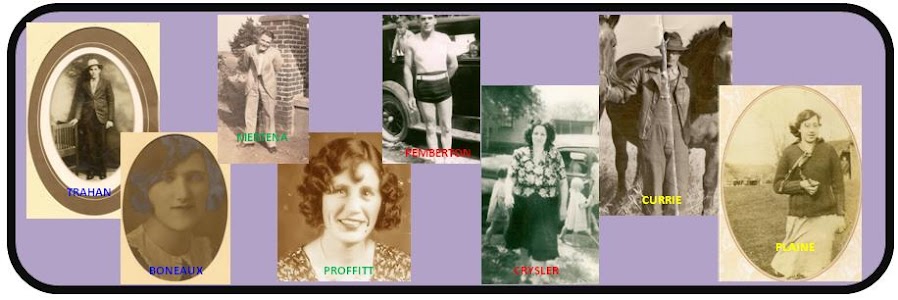
I am using a variation of the color coding system suggested by the Family Roots Organizer System. All my paternal grandfathers' (Trahan) ancestors will have blue folders; all my paternal grandmothers' (Mertena) ancestors will have green folders; all my maternal grandfathers' (Pemberton) ancestors will have red folders; and all my maternal grandmothers' (Currie) ancestors will have purple folders. Why purple instead of yellow? Yellow is the color suggested, but my grandmother's name was Violet, and she liked the color purple. Plus, I am also using this color coding in RootsMagic, and the yellow text is hard to see.
I already have colored hanging folders for each of the surnames of my 16 great-great-grandparents. I am alphabetizing them by color. For example, all my blues are in alphabetical order, followed by the greens, etc. So far, within my blue folders, I have one manila file folder each for myself, my parents, my two uncles who married, and my paternal grandparents. I am currently working on the folder for my great-grandparents, Bienvenue TRAHAN and Beatrice Marie BONEAUX. In each of the manila folders, I have family group sheets, individual summary reports for husband and wife, discrepancy charts (when necessary), research checklists and to-do lists, and all of their documents, beginning with the marriage record. I also have documents for their children who never married. When I get back into the generation of my great-great-grandparents, I am going to add research logs, research notes, and county/state maps. As I am going through the documents in the paper files, I am scanning them and adding the source citations to my RootsMagic database.
As suggested by the Family Roots Organizer System, I am putting all my direct line manila folders on the folder with the right tab. One variation I am making is the order of the folders. The Family Roots Organizer System suggests to order each couple folder alphabetically using the husband's name, but I'm going to order them in ahnentafel order. Within the Trahan folder, my folder will be first, then my parents' folder, then my grandparents' folder, etc. The siblings of my direct line ancestors will have manila folders behind the folder of the direct line sibling, but they will be on the middle tab and have a blue/green/red/purple dot to easily identify them as collaterals. Any of the documents for children and grandchildren of the siblings will also go in the sibling's manila folder. I think I will use colored paper to divide the manila folder for siblings into sections for their children and grandchildren. I am using the manila folders with left tabs for things such as Pedigree Charts (one for each surname beginning with the youngest direct line ancestor in the line), Research Not Yet Proven, Correspondence, etc.
Once I get manila folders set up for all my couples on the five-generation pedigree chart, then I will finish sorting out all my other paper files. I have four banker's boxes sitting at the end of my spare bed right now, one for each grandparent.
This is where I have my paper files that are currently in surname folders (no couple folders). I also have several binders of paper files filed by type of record rather than surname (not sure what I was thinking with this filing system) that I have not put into the boxes yet. Basically, I am combining two paper filing systems into one new one with very pretty colors. The reason I had two filing systems previously is because I started out with surname and then changed to type of record. I am so ready to be on one paper system.
In the future, I need to decide what to do with my collateral spouse research. For instance, I have done much research on a couple of my aunts' and uncles' sides of the family. For now, I will just leave those files digitized. I do have some paper files for those lines, but I will keep them to the side until I am done organizing my direct line and direct line siblings papers.
Well, I had better get back to organizing, scanning, and citing! If anyone has suggestions for my new system, please share in the comments. Thanks!
Wednesday, April 10, 2013
RootsMagic Database Source/Event Cleanup Complete!
Yes, you heard right. My source/event cleanup project that has been going on and off for about 3 years now is complete. I feel a huge burden lifted off my shoulders. Because I have an obsession with order, it made me anxious for the last three years to work in the database without everything being neat and organized. So I would go through spurts of doing cleanup and then stopping to do research and then getting tired of looking at the mess and starting where I left off with the cleanup again.
What was the main problem? Well, the main problem was that I started a database in Legacy 6.0 before the Evidence Explained based source templates were available. When Legacy made them available with Legacy 7.0, I started converting my sources to the proper templates. Then midway, I decided to switch to RootsMagic. Once I did the database conversion, the sources got all garbled again.
The other problem was that I did not like the way that I entered events in Legacy. I had multiple instances with one source each when I could have just had one event with multiple sources. I also added some new events that I had not been using, such as the "census" event.
While I was at it, I also updated a lot of info from new online sources, such as the city directories at Ancestry.com and the 1940 census.
Another problem was that I didn't have the source detail text entered with the source citation, so I added source detail text to each citation.
Now that I've fixed most of this stuff, I've just been doing minor cleanup with my digital files. I've reorganized some of them and changed a few file names. I find changing file names to be tedious, though, so I've just been doing one family at a time. I will probably only change the file names for my direct line ancestor documents. I've decided to start doing my filenames in the format Year LastName GivenNames Description. For example: 1928 Pemberton John P. Birth. This sorts my files by date order. Previously, I did not really have a standard file name format.
Now I need to start working on entering about 5-10 documents that I sporadically ordered from various vital records repositories and such while I was doing cleanup. I have them in a To Be Entered folder sitting on my nightstand.
I also need to attack my paper files and reorganize them. Currently, I have them organized by surname with no sub-folders, but I would like to create sub-folders for each married couple. I would like to get away from paper as much as possible, but I'm not 100% sure that I can part with everything. I definitely cannot part with old family documents. I have all my digital files backed up on Mozy and I have them synced with Dropbox, so I think they are pretty safe. I can probably part with documents that I've printed from microfilm and online once I make sure I have a digital copy.
Then I need to get back to research full-time. Not sure where I want to start. I know there are several records on the families I already have in my database that I need to order. I should probably start there. For instance, I have several citations from the "Michigan Death Index, 1971-1996 "at Ancestry.com, but we all know that an index is not a true source citation. It's just a clue of where to find the original source. I need to run a list of all people in my database with that source attached and determine who I need to order death records for. For some of the really distant cousins or collaterals, I will probably just leave the index as the citation for now.
Once I revisit everyone already in my database, I will probably start to focus on finding sources for another family line. The majority of people already in my database are from the Pemberton line, my mother's paternal line. It's so hard to pick which line to start with, though. I guess I could start with my great-great-grandparents and work each line in ahnentafel order.
So, the major cleanup project is done! What a relief! Now I just have a few minor projects to get on and then I can get back to real research! So excited!
What was the main problem? Well, the main problem was that I started a database in Legacy 6.0 before the Evidence Explained based source templates were available. When Legacy made them available with Legacy 7.0, I started converting my sources to the proper templates. Then midway, I decided to switch to RootsMagic. Once I did the database conversion, the sources got all garbled again.
The other problem was that I did not like the way that I entered events in Legacy. I had multiple instances with one source each when I could have just had one event with multiple sources. I also added some new events that I had not been using, such as the "census" event.
While I was at it, I also updated a lot of info from new online sources, such as the city directories at Ancestry.com and the 1940 census.
Another problem was that I didn't have the source detail text entered with the source citation, so I added source detail text to each citation.
Now that I've fixed most of this stuff, I've just been doing minor cleanup with my digital files. I've reorganized some of them and changed a few file names. I find changing file names to be tedious, though, so I've just been doing one family at a time. I will probably only change the file names for my direct line ancestor documents. I've decided to start doing my filenames in the format Year LastName GivenNames Description. For example: 1928 Pemberton John P. Birth. This sorts my files by date order. Previously, I did not really have a standard file name format.
Now I need to start working on entering about 5-10 documents that I sporadically ordered from various vital records repositories and such while I was doing cleanup. I have them in a To Be Entered folder sitting on my nightstand.
I also need to attack my paper files and reorganize them. Currently, I have them organized by surname with no sub-folders, but I would like to create sub-folders for each married couple. I would like to get away from paper as much as possible, but I'm not 100% sure that I can part with everything. I definitely cannot part with old family documents. I have all my digital files backed up on Mozy and I have them synced with Dropbox, so I think they are pretty safe. I can probably part with documents that I've printed from microfilm and online once I make sure I have a digital copy.
Then I need to get back to research full-time. Not sure where I want to start. I know there are several records on the families I already have in my database that I need to order. I should probably start there. For instance, I have several citations from the "Michigan Death Index, 1971-1996 "at Ancestry.com, but we all know that an index is not a true source citation. It's just a clue of where to find the original source. I need to run a list of all people in my database with that source attached and determine who I need to order death records for. For some of the really distant cousins or collaterals, I will probably just leave the index as the citation for now.
Once I revisit everyone already in my database, I will probably start to focus on finding sources for another family line. The majority of people already in my database are from the Pemberton line, my mother's paternal line. It's so hard to pick which line to start with, though. I guess I could start with my great-great-grandparents and work each line in ahnentafel order.
So, the major cleanup project is done! What a relief! Now I just have a few minor projects to get on and then I can get back to real research! So excited!
Sunday, March 24, 2013
The Genealogical Journey of a 30-Something
A few weeks ago, James Tanner of Genealogy's Star posted about the Genealogy Age Gap. His post asked what the genealogy community could do to include more young people. It had a slightly negative slant to it about his hope for the younger generation and their ability to be competent genealogists. It caused a lively discussion in the Comments section, and Elyse (a 20-something genealogist) wrote a rebuttal post titled "Young People Aren't Interested in Genealogy?" This topic has always interested me, as I've always considered myself one of the younger genealogists and quite frankly, I had no idea there were any others until I discovered the blogging community about four years ago.
I began my journey when I was about 12 years old. I was somewhat rebellious, and my paternal grandmother thought I needed a hobby. She was interested in genealogy, and I was always asking her questions about her family, so she suggested we visit the local genealogy library in Lake Charles, Louisiana. This was around 1993-94, before the Internet really became popular with the general public. When we got to the library, we quickly realized most of their sources were for Louisiana, and only my paternal grandfather's family was from Louisiana. But, hey, it was a start. The librarians were so excited that a young person was interested in genealogy. They and other library patrons told me about citing my sources, but of course, I did not listen. Who had time for that? I just wanted to know who my ancestors were. I was able to go back several generations on my paternal grandfather's line and over the next four years or so, my grandmother and I made several trips to the library to explore my paternal grandfather's extended and collateral lines. My main sources for research were several books of Southwest Louisiana Catholic church sacramental record abstracts and a few books on Acadian family lines. It never even occurred to me at the time to order copies of the church records. I didn't even know the difference between primary and secondary sources. Being so young, I was obviously unable to travel to research any other sides of my family, considering they were from Oklahoma and Michigan.
I discovered the Internet for genealogy research when I was about 16 years old around 1997. My main discoveries were WorldConnect family trees and Family Tree Maker trees published online. This is how I first started researching my maternal lines and my paternal grandmother's family. I also used the online trees to discover more information on my paternal grandfather's line without having to visit the library. At this point, I started using Family Tree Maker and started copying and pasting all the unsourced info into the software. Aside from family trees, I discovered Vitalrec.com and started to dabble in ordering vital records from Michigan. This was probably my first experience with primary sources found outside the family (I had a few vital records that my grandmothers had, such as my great-grandfather's death certificate). I also visited a courthouse in Michigan while I was in college. From the time I was 16 until I was about 23, my research was very sporadic, as high school and college took precedence in my life.
Right before my 24th birthday (c. 2005) is when I REALLY started to become more serious about genealogy. Of course, it depends how you define "serious." I guess you could say I started spending more time on it. I updated Family Tree Maker and started to actually cite my sources (it only took 12 years). I subscribed to Ancestry.com that year and discovered census records. I also started ordering more vital records for my Michigan ancestors. My research slowed down a little in 2006 while I was in grad school.
After grad school, I switched over to Legacy Family Tree in 2007. Instead of importing my FTM file, I started over because of all the unsourced info I had in FTM. However, I was still copying and pasting those unsourced family trees in Legacy. The only difference was that I was actually citing those unsourced family trees as sources. Silly me.
I discovered genealogy blogs in January 2009 and quickly started my own. This is when I really started to feel part of a genealogy community. I also learned to stop citing those trees as sources. Instead, I started copying and pasting the info into Notes for further research, along with a reference to the website. I started trying to follow Elizabeth Shown Mills' citation examples in Evidence Explained. Since fall 2009, I've been cleaning up sources that I finally started to cite back in 2005. My original citations were fairly elementary and when I switched to RootsMagic in fall 2009, some of them got jumbled. I've also been moving the info from unsourced trees to the Notes section for individuals.
Currently, I probably spend about 2 hours a day during the week on genealogy research. A lot of my research is done online at FamilySearch and Ancestry.com, as well as a few other sites. On the weekends, I spend about 4 hours a day (or more). I don't do a lot of traveling, though I occasionally go to the Louisiana State Archives or the local genealogy library here in Baton Rouge. I also visit the local Family History Center from time to time. I try to fit in research at the library and courthouse when I visit cousins in Michigan, but the living take priority so I don't always get as much done as I'd like. My dream is to buy a summer house in Michigan when I retire and do my research. I can't wait to retire so I can spend more time on genealogy research.
Overall, I think I've matured a lot in my research since my early days. I am curious whether or not most researchers go through these phases. I probably stayed in the earlier phases longer than those who start out older. With the advent of the Internet, I also think the beginning stage has probably been revamped. People are no longer limited to their local resources. I seem to have matured faster since my involvement in blogging.
I began my journey when I was about 12 years old. I was somewhat rebellious, and my paternal grandmother thought I needed a hobby. She was interested in genealogy, and I was always asking her questions about her family, so she suggested we visit the local genealogy library in Lake Charles, Louisiana. This was around 1993-94, before the Internet really became popular with the general public. When we got to the library, we quickly realized most of their sources were for Louisiana, and only my paternal grandfather's family was from Louisiana. But, hey, it was a start. The librarians were so excited that a young person was interested in genealogy. They and other library patrons told me about citing my sources, but of course, I did not listen. Who had time for that? I just wanted to know who my ancestors were. I was able to go back several generations on my paternal grandfather's line and over the next four years or so, my grandmother and I made several trips to the library to explore my paternal grandfather's extended and collateral lines. My main sources for research were several books of Southwest Louisiana Catholic church sacramental record abstracts and a few books on Acadian family lines. It never even occurred to me at the time to order copies of the church records. I didn't even know the difference between primary and secondary sources. Being so young, I was obviously unable to travel to research any other sides of my family, considering they were from Oklahoma and Michigan.
I discovered the Internet for genealogy research when I was about 16 years old around 1997. My main discoveries were WorldConnect family trees and Family Tree Maker trees published online. This is how I first started researching my maternal lines and my paternal grandmother's family. I also used the online trees to discover more information on my paternal grandfather's line without having to visit the library. At this point, I started using Family Tree Maker and started copying and pasting all the unsourced info into the software. Aside from family trees, I discovered Vitalrec.com and started to dabble in ordering vital records from Michigan. This was probably my first experience with primary sources found outside the family (I had a few vital records that my grandmothers had, such as my great-grandfather's death certificate). I also visited a courthouse in Michigan while I was in college. From the time I was 16 until I was about 23, my research was very sporadic, as high school and college took precedence in my life.
Right before my 24th birthday (c. 2005) is when I REALLY started to become more serious about genealogy. Of course, it depends how you define "serious." I guess you could say I started spending more time on it. I updated Family Tree Maker and started to actually cite my sources (it only took 12 years). I subscribed to Ancestry.com that year and discovered census records. I also started ordering more vital records for my Michigan ancestors. My research slowed down a little in 2006 while I was in grad school.
After grad school, I switched over to Legacy Family Tree in 2007. Instead of importing my FTM file, I started over because of all the unsourced info I had in FTM. However, I was still copying and pasting those unsourced family trees in Legacy. The only difference was that I was actually citing those unsourced family trees as sources. Silly me.
I discovered genealogy blogs in January 2009 and quickly started my own. This is when I really started to feel part of a genealogy community. I also learned to stop citing those trees as sources. Instead, I started copying and pasting the info into Notes for further research, along with a reference to the website. I started trying to follow Elizabeth Shown Mills' citation examples in Evidence Explained. Since fall 2009, I've been cleaning up sources that I finally started to cite back in 2005. My original citations were fairly elementary and when I switched to RootsMagic in fall 2009, some of them got jumbled. I've also been moving the info from unsourced trees to the Notes section for individuals.
Currently, I probably spend about 2 hours a day during the week on genealogy research. A lot of my research is done online at FamilySearch and Ancestry.com, as well as a few other sites. On the weekends, I spend about 4 hours a day (or more). I don't do a lot of traveling, though I occasionally go to the Louisiana State Archives or the local genealogy library here in Baton Rouge. I also visit the local Family History Center from time to time. I try to fit in research at the library and courthouse when I visit cousins in Michigan, but the living take priority so I don't always get as much done as I'd like. My dream is to buy a summer house in Michigan when I retire and do my research. I can't wait to retire so I can spend more time on genealogy research.
Overall, I think I've matured a lot in my research since my early days. I am curious whether or not most researchers go through these phases. I probably stayed in the earlier phases longer than those who start out older. With the advent of the Internet, I also think the beginning stage has probably been revamped. People are no longer limited to their local resources. I seem to have matured faster since my involvement in blogging.
Subscribe to:
Posts (Atom)

