I posted several weeks ago about the need to clean up my office as one of the warm-up exercises for the 2017 Genealogy Do-Over. I am excited to announce that my aunt came to visit this weekend and single-handedly cleaned the office for me! I can now research peacefully without stress about all the boxes sitting to the side. I still need to go through the boxes, as they contain various documents and photos from my paternal grandparents. But at least for now they are stacked neatly in the office closet and I can review the contents when I am ready. The closet is also a safer place for the old photos, as there is less light in the closet. Here are some pics of my new clean office (sorry, did not take any before photos, but just imagine two rows of boxes stacked all along the wall with the window).
The clean desk and the wall with the window are my favorite parts! Let's hope I can keep it this way...
Pages
Title Header
Showing posts with label Organization. Show all posts
Sunday, April 23, 2017
Clean Office!
Saturday, May 11, 2013
Changing the Way I Create Facts in RootsMagic
Now that I am well on my way to organizing my paper files and making sure all my sources for my 16 great-great-grandparents are properly cited in my database, I am changing up the way I create Facts/Events in RootsMagic. Back in February 2012, Randy Seaver over at GeneaMusings started a discussion about evidence-based vs. conclusion-based genealogists. Essentially, Randy defined an evidence-based genealogist as one who would create five different facts for the same event given five difference sources. A conclusion-based genealogist would create one fact for an event and cite one or multiple sources for this one fact. Basically, a conclusion-based genealogist comes to a conclusion based upon all the sources and only records one fact, rather than presenting all five facts as an evidence-based genealogist would.
The discussion started to make me think about whether or not I was evidence-based or conclusion-based. Until now, I was mostly evidence-based. For my great-grandfather Bienvenue Trahan's birth, I have the following sources:
When all of this discussion was going on back in 2012, I read a post over at Genealogy by Ginger's Blog, in which she discussed how she is a hybrid of the evidence and conclusion-based genealogist. She stated that she only puts one fact into her RootsMagic database, but she cites all sources and discusses the alternative facts in the Notes section of the event. This creates less duplication when creating narrative reports in RootsMagic. I really liked Ginger's idea, so I decided to try it on my own. Now for Bienvenue, his screen looks like this:
Now there is only one fact for his Birth and whenever I print a narrative report, I can see the Birth Notes explaining all the discrepancies in his birth information:
Many thanks to Ginger for giving me this wonderful idea!
The discussion started to make me think about whether or not I was evidence-based or conclusion-based. Until now, I was mostly evidence-based. For my great-grandfather Bienvenue Trahan's birth, I have the following sources:
- Baptismal record dated 12 Dec 1908: Born 26 Oct 1908
- 1910 U.S. Census: age 1 - born about 1909 in Louisiana (note: age supports birth date of 26 Oct 1908)
- 1930 U.S. Census: age 20 - born about 1910 in Louisiana (living with in-laws)
- 1940 U.S. Census: age 33 - born about 1907 in Louisiana; his wife, Beatrice, is marked as the informant
- Death certificate dated 18 Mar 2006: Born 26 Oct 1908 in Scott, Louisiana; informant is son, Benford M. Trahan
- Obituary dated 20 Mar 2006 published in Lake Charles American Press: age 97 - born about 1909 (note: age supports birth date of 26 Oct 1908)
- Gravestone at Sts. Peter and Paul Cemetery in Scott, Louisiana - Born 26 Oct 1908
- SSDI Entry: Born 26 Oct 1908
- Marriage record of son, Benford, 02 Feb 1955 - Father born in Louisiana
- Delayed birth record of son, Benford, 08 Nov 1988 - Father born in Louisiana
- Death certificate of son, Benford, 06 Sep 2009 - Father born in Vatican, Louisiana; informant is Bienvenue's daughter-in-law, Merlene (Mertena) Trahan
- Interview with Bienvenue published in Vinton News, 04 Jun 1998: listed as age 89 and a "native of Vatican...7 miles north of Scott"
- Birth: 26 Oct 1908, Vatican, Lafayette, Louisiana (sources: baptismal record, 1910 census, obituary, gravestone, SSDI entry, marriage record of son, delayed birth record of son, newspaper article, death certificate of son)
- Alt. Birth: 26 Oct 1908 in Scott, Lafayette, Louisiana (source: death certificate)
- Alt. Birth: abt 1910 in Louisiana (source: 1930 census)
- Alt. Birth: abt 1907 in Louisiana (source: 1940 census)
When all of this discussion was going on back in 2012, I read a post over at Genealogy by Ginger's Blog, in which she discussed how she is a hybrid of the evidence and conclusion-based genealogist. She stated that she only puts one fact into her RootsMagic database, but she cites all sources and discusses the alternative facts in the Notes section of the event. This creates less duplication when creating narrative reports in RootsMagic. I really liked Ginger's idea, so I decided to try it on my own. Now for Bienvenue, his screen looks like this:
Now there is only one fact for his Birth and whenever I print a narrative report, I can see the Birth Notes explaining all the discrepancies in his birth information:
Many thanks to Ginger for giving me this wonderful idea!
Wednesday, April 24, 2013
Paper Files Organization Project
I just can't seem to stay away from organizing. I just finished a huge database cleanup project, and now I've moved on to organizing my paper files. In fact, in my last post, I said I was going to do away with my paper files, except for really old original documents. Well, I've changed my mind. I started reading DearMyrtle's organization checklists and then I watched the Legacy webinar about the Family Roots Organizer System. And my little organization-loving heart just could not bear to part with the paper files. In fact, it decided to create more paper files.
The main convincing argument was one by DearMyrtle: it peaks family members' interest when they have something tangible in their hands to read like a book. Who is going to be interested in my digital filing system? Don't worry. I am still keeping my digital filing system, but I am also keeping the paper files to share with others.
Unlike DearMyrtle, I am using file folders rather than binders to organize my paper files. I find that binders take up too much space, and since we haven't bought a house yet and still live in an apartment, it's much easier to find space for a filing cabinet. The only thing I don't like about file folders is the ability of the papers to get loose. To help with that, I am putting two-hole prongs inside each folder and punching holes in all my documents. Don't worry. There are no original documents that I will be punching holes in.
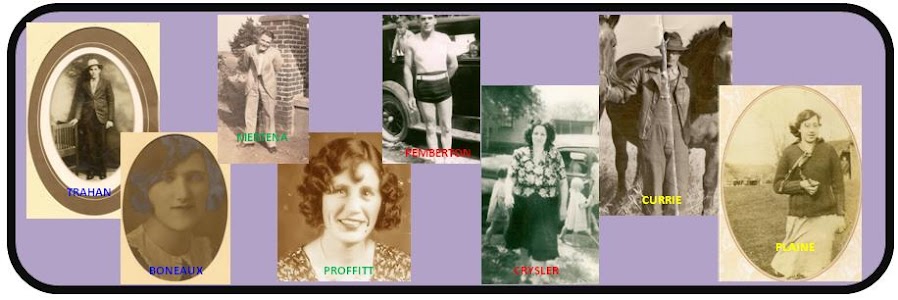
I am using a variation of the color coding system suggested by the Family Roots Organizer System. All my paternal grandfathers' (Trahan) ancestors will have blue folders; all my paternal grandmothers' (Mertena) ancestors will have green folders; all my maternal grandfathers' (Pemberton) ancestors will have red folders; and all my maternal grandmothers' (Currie) ancestors will have purple folders. Why purple instead of yellow? Yellow is the color suggested, but my grandmother's name was Violet, and she liked the color purple. Plus, I am also using this color coding in RootsMagic, and the yellow text is hard to see.
I already have colored hanging folders for each of the surnames of my 16 great-great-grandparents. I am alphabetizing them by color. For example, all my blues are in alphabetical order, followed by the greens, etc. So far, within my blue folders, I have one manila file folder each for myself, my parents, my two uncles who married, and my paternal grandparents. I am currently working on the folder for my great-grandparents, Bienvenue TRAHAN and Beatrice Marie BONEAUX. In each of the manila folders, I have family group sheets, individual summary reports for husband and wife, discrepancy charts (when necessary), research checklists and to-do lists, and all of their documents, beginning with the marriage record. I also have documents for their children who never married. When I get back into the generation of my great-great-grandparents, I am going to add research logs, research notes, and county/state maps. As I am going through the documents in the paper files, I am scanning them and adding the source citations to my RootsMagic database.
As suggested by the Family Roots Organizer System, I am putting all my direct line manila folders on the folder with the right tab. One variation I am making is the order of the folders. The Family Roots Organizer System suggests to order each couple folder alphabetically using the husband's name, but I'm going to order them in ahnentafel order. Within the Trahan folder, my folder will be first, then my parents' folder, then my grandparents' folder, etc. The siblings of my direct line ancestors will have manila folders behind the folder of the direct line sibling, but they will be on the middle tab and have a blue/green/red/purple dot to easily identify them as collaterals. Any of the documents for children and grandchildren of the siblings will also go in the sibling's manila folder. I think I will use colored paper to divide the manila folder for siblings into sections for their children and grandchildren. I am using the manila folders with left tabs for things such as Pedigree Charts (one for each surname beginning with the youngest direct line ancestor in the line), Research Not Yet Proven, Correspondence, etc.
Once I get manila folders set up for all my couples on the five-generation pedigree chart, then I will finish sorting out all my other paper files. I have four banker's boxes sitting at the end of my spare bed right now, one for each grandparent.
This is where I have my paper files that are currently in surname folders (no couple folders). I also have several binders of paper files filed by type of record rather than surname (not sure what I was thinking with this filing system) that I have not put into the boxes yet. Basically, I am combining two paper filing systems into one new one with very pretty colors. The reason I had two filing systems previously is because I started out with surname and then changed to type of record. I am so ready to be on one paper system.
In the future, I need to decide what to do with my collateral spouse research. For instance, I have done much research on a couple of my aunts' and uncles' sides of the family. For now, I will just leave those files digitized. I do have some paper files for those lines, but I will keep them to the side until I am done organizing my direct line and direct line siblings papers.
Well, I had better get back to organizing, scanning, and citing! If anyone has suggestions for my new system, please share in the comments. Thanks!
Wednesday, April 10, 2013
RootsMagic Database Source/Event Cleanup Complete!
Yes, you heard right. My source/event cleanup project that has been going on and off for about 3 years now is complete. I feel a huge burden lifted off my shoulders. Because I have an obsession with order, it made me anxious for the last three years to work in the database without everything being neat and organized. So I would go through spurts of doing cleanup and then stopping to do research and then getting tired of looking at the mess and starting where I left off with the cleanup again.
What was the main problem? Well, the main problem was that I started a database in Legacy 6.0 before the Evidence Explained based source templates were available. When Legacy made them available with Legacy 7.0, I started converting my sources to the proper templates. Then midway, I decided to switch to RootsMagic. Once I did the database conversion, the sources got all garbled again.
The other problem was that I did not like the way that I entered events in Legacy. I had multiple instances with one source each when I could have just had one event with multiple sources. I also added some new events that I had not been using, such as the "census" event.
While I was at it, I also updated a lot of info from new online sources, such as the city directories at Ancestry.com and the 1940 census.
Another problem was that I didn't have the source detail text entered with the source citation, so I added source detail text to each citation.
Now that I've fixed most of this stuff, I've just been doing minor cleanup with my digital files. I've reorganized some of them and changed a few file names. I find changing file names to be tedious, though, so I've just been doing one family at a time. I will probably only change the file names for my direct line ancestor documents. I've decided to start doing my filenames in the format Year LastName GivenNames Description. For example: 1928 Pemberton John P. Birth. This sorts my files by date order. Previously, I did not really have a standard file name format.
Now I need to start working on entering about 5-10 documents that I sporadically ordered from various vital records repositories and such while I was doing cleanup. I have them in a To Be Entered folder sitting on my nightstand.
I also need to attack my paper files and reorganize them. Currently, I have them organized by surname with no sub-folders, but I would like to create sub-folders for each married couple. I would like to get away from paper as much as possible, but I'm not 100% sure that I can part with everything. I definitely cannot part with old family documents. I have all my digital files backed up on Mozy and I have them synced with Dropbox, so I think they are pretty safe. I can probably part with documents that I've printed from microfilm and online once I make sure I have a digital copy.
Then I need to get back to research full-time. Not sure where I want to start. I know there are several records on the families I already have in my database that I need to order. I should probably start there. For instance, I have several citations from the "Michigan Death Index, 1971-1996 "at Ancestry.com, but we all know that an index is not a true source citation. It's just a clue of where to find the original source. I need to run a list of all people in my database with that source attached and determine who I need to order death records for. For some of the really distant cousins or collaterals, I will probably just leave the index as the citation for now.
Once I revisit everyone already in my database, I will probably start to focus on finding sources for another family line. The majority of people already in my database are from the Pemberton line, my mother's paternal line. It's so hard to pick which line to start with, though. I guess I could start with my great-great-grandparents and work each line in ahnentafel order.
So, the major cleanup project is done! What a relief! Now I just have a few minor projects to get on and then I can get back to real research! So excited!
What was the main problem? Well, the main problem was that I started a database in Legacy 6.0 before the Evidence Explained based source templates were available. When Legacy made them available with Legacy 7.0, I started converting my sources to the proper templates. Then midway, I decided to switch to RootsMagic. Once I did the database conversion, the sources got all garbled again.
The other problem was that I did not like the way that I entered events in Legacy. I had multiple instances with one source each when I could have just had one event with multiple sources. I also added some new events that I had not been using, such as the "census" event.
While I was at it, I also updated a lot of info from new online sources, such as the city directories at Ancestry.com and the 1940 census.
Another problem was that I didn't have the source detail text entered with the source citation, so I added source detail text to each citation.
Now that I've fixed most of this stuff, I've just been doing minor cleanup with my digital files. I've reorganized some of them and changed a few file names. I find changing file names to be tedious, though, so I've just been doing one family at a time. I will probably only change the file names for my direct line ancestor documents. I've decided to start doing my filenames in the format Year LastName GivenNames Description. For example: 1928 Pemberton John P. Birth. This sorts my files by date order. Previously, I did not really have a standard file name format.
Now I need to start working on entering about 5-10 documents that I sporadically ordered from various vital records repositories and such while I was doing cleanup. I have them in a To Be Entered folder sitting on my nightstand.
I also need to attack my paper files and reorganize them. Currently, I have them organized by surname with no sub-folders, but I would like to create sub-folders for each married couple. I would like to get away from paper as much as possible, but I'm not 100% sure that I can part with everything. I definitely cannot part with old family documents. I have all my digital files backed up on Mozy and I have them synced with Dropbox, so I think they are pretty safe. I can probably part with documents that I've printed from microfilm and online once I make sure I have a digital copy.
Then I need to get back to research full-time. Not sure where I want to start. I know there are several records on the families I already have in my database that I need to order. I should probably start there. For instance, I have several citations from the "Michigan Death Index, 1971-1996 "at Ancestry.com, but we all know that an index is not a true source citation. It's just a clue of where to find the original source. I need to run a list of all people in my database with that source attached and determine who I need to order death records for. For some of the really distant cousins or collaterals, I will probably just leave the index as the citation for now.
Once I revisit everyone already in my database, I will probably start to focus on finding sources for another family line. The majority of people already in my database are from the Pemberton line, my mother's paternal line. It's so hard to pick which line to start with, though. I guess I could start with my great-great-grandparents and work each line in ahnentafel order.
So, the major cleanup project is done! What a relief! Now I just have a few minor projects to get on and then I can get back to real research! So excited!
Friday, December 9, 2011
Cleaning Up My Database: Lovell and Alvina (Lesperance) PEMBERTON
Since I am going family by family cleaning up source citations in my database, I figured I would share some of the sources that I have for the current family I am working. I am working on cleaning up the source citations for the family of my great-great-grandparents, Lovell and Alvina (Lesperance) Pemberton.
Lovell Hugh Pemberton was born 14 Jan 1878 in Almont, Lapeer, Michigan, to John C. Pemberton and Mary Ann Coombs. The funny thing about Lovell is that his birth certificate says he was born 14 Jan 1878, but his father's Civil War pension file and his own WWI draft registration card, death record, and obituary all give his birthday as either 17 Apr 1878 or 17 Apr 1879. I have yet to figure the mystery out. Lovell died 23 Mar 1952 in Lexington, Sanilac, Michigan, and is buried in St. Denis Catholic Cemetery in Lexington.
Alvina Mary Lesperance was born 27 Nov 1881 in Anchorville, St. Clair, Michigan, to Charles Lesperance and Christine Goslin. She died 16 Jun 1961 in Lexington, Sanilac, Michigan, and is buried with Lovell.
Lovell and Alvina married 10 Nov 1902 in Anchorville, St. Clair, Michigan, at Immaculate Conception Catholic Church. They had 13 children, only 6 of whom survived to adulthood.
When I clean up source citations on a family, I usually start with the children first. With Lovell and Alvina, I started with their seven children who died in childhood first, since they had the least amount of sources. Now I am working on the other children. Below are the sources I have for their children:
d. 21 Jun 1913 in Mount Clemens, Macomb, Michigan
Sources:
m. 9 Jun 1925 in St. Clair, St. Clair, Michigan to Darcy Merle VAN BUSKIRK
d. 18 Jan 1967 in Torrance, Los Angeles, California
Sources:
b. 19 Feb 1908 in Mount Clemens, Macomb, Michigan
m. 7 Aug 1927 in Port Huron, St. Clair, Michigan to Mabel Ellen CRYSLER
d. 22 Nov 1950 in Ann Arbor, Washtenaw, Michigan
Sources:
b. 2 May 1910 in Mount Clemens, Macomb, Michigan
d. 25 Sep 1910 in Mount Clemens, Macomb, Michigan
Sources:
m. 21 Oct 1933 in Croswell, Sanilac, Michigan to Leo Clayton CARNAHAN
d. 18 Nov 1961 in Torrance, Los Angeles, California
Sources:
d. 15 Sep 1914 in Mount Clemens, Macomb, Michigan
Sources:
m. 10 Nov 1934 in Croswell, Sanilac, Michigan to Vera Delores BARNES
d. 22 Aug 1972 in Port Huron, St. Clair, Michigan
Sources:
m. 26 Oct 1938 in Croswell, Sanilac, Michigan to Truman Elnathan ROWLEY
d. 24 Jun 2001 in Port Huron, St. Clair, Michigan
Sources:
d. 23 Mar 1919 in Marine City, St. Clair, Michigan
m. 11 May 1938 in Croswell, Sanilac, Michigan to Daniel Robert BEEDON
m. 21 Jan 1956 in Angola, Steuben, Indiana to Arnold Frederick DISTELRATH
d. 12 Nov 1997 in Fort Gratiot, St. Clair, Michigan
Sources:
d. 22 Mar 1921 in St. Clair, St. Clair, Michigan
Sources:
d. 14 Aug 1923 in Marysville, St. Clair, Michigan
Sources:
d. 28 Dec 1928 in Port Huron, St. Clair, Michigan
Sources:
Lovell Hugh Pemberton was born 14 Jan 1878 in Almont, Lapeer, Michigan, to John C. Pemberton and Mary Ann Coombs. The funny thing about Lovell is that his birth certificate says he was born 14 Jan 1878, but his father's Civil War pension file and his own WWI draft registration card, death record, and obituary all give his birthday as either 17 Apr 1878 or 17 Apr 1879. I have yet to figure the mystery out. Lovell died 23 Mar 1952 in Lexington, Sanilac, Michigan, and is buried in St. Denis Catholic Cemetery in Lexington.
Alvina Mary Lesperance was born 27 Nov 1881 in Anchorville, St. Clair, Michigan, to Charles Lesperance and Christine Goslin. She died 16 Jun 1961 in Lexington, Sanilac, Michigan, and is buried with Lovell.
Lovell and Alvina married 10 Nov 1902 in Anchorville, St. Clair, Michigan, at Immaculate Conception Catholic Church. They had 13 children, only 6 of whom survived to adulthood.
When I clean up source citations on a family, I usually start with the children first. With Lovell and Alvina, I started with their seven children who died in childhood first, since they had the least amount of sources. Now I am working on the other children. Below are the sources I have for their children:
Gilbert Lowell PEMBERTON
b. 8 May 1903 in Ontario or Michigand. 21 Jun 1913 in Mount Clemens, Macomb, Michigan
Sources:
- 1910 census in household of Lovell and Alvina at 208 Gratiot Ave. in Mt. Clemens, Macomb, Michigan (Ancestry.com)
- 1913 state death certificate from "Deaths, 1897-1920" at SeekingMichigan.org
- 1913 death announcement in Mount Clemens Monitor obtained from a lookup volunteer at Mt. Clemens Public Library
Nellie Mary PEMBERTON
b. 25 Oct 1905 in Chesterfield, Macomb, Michiganm. 9 Jun 1925 in St. Clair, St. Clair, Michigan to Darcy Merle VAN BUSKIRK
d. 18 Jan 1967 in Torrance, Los Angeles, California
Sources:
- 1910 census in household of Lovell and Alvina at 208 Gratiot Ave. in Mt. Clemens, Macomb, Michigan (Ancestry.com)
- 1920 census in household of Lovell and Alvina at 700 N. Vine St. in St. Clair, St. Clair, Michigan (Ancestry.com)
- 1925 marriage register entry transcribed at St. Clair County Courthouse in summer 2007
- 1930 census with her husband and young daughter at Hathway Street in East China Township, St. Clair, Michigan (Ancestry.com)
- Port Huron City Directory obtained from St. Clair County Public Library digital collection
- 1930: 1016-14th St.
- 1936-37, 1938-39: 1814-17th St.
- 1950 mentioned in her brother John's obituary as residing in Port Huron, St. Clair, Michigan
- 1952 mentioned in her father's obituary as residing in Port Huron, St. Clair, Michigan
- 1961 mentioned in her mother's obituary as residing in Port Huron, St Clair, Michigan
- 1961 mentioned in her sister Madeline's obituary as residing in Port Huron, St. Clair, Michigan
- 1967 death certificate obtained by mail from Los Angeles County Recorder's office
- 1967 obituary from Port Huron Times-Herald obtained from St. Clair County Public Library in summer 2007
- Letter from Los Angeles Archdiocese giving exact burial location in All Souls Cemetery in Long Beach. Asked a volunteer from FindAGrave to take a pic, but there was no headstone.
b. 19 Feb 1908 in Mount Clemens, Macomb, Michigan
m. 7 Aug 1927 in Port Huron, St. Clair, Michigan to Mabel Ellen CRYSLER
d. 22 Nov 1950 in Ann Arbor, Washtenaw, Michigan
Sources:
- 1908 birth certificate obtained by mail from Michigan Department of Community Health
- 1908 birth register entry from Macomb County Clerk FHL microfilm #979569
- 1910 census in household of Lovell and Alvina at 208 Gratiot Ave. in Mt. Clemens, Macomb, Michigan (Ancestry.com)
- 1920 census in household of Lovell and Alvina at 700 N. Vine St. in St. Clair, St. Clair, Michigan (Ancestry.com)
- 1925 witnessed marriage of sister Nellie and her husband, Darcy
- 1927 marriage certificate obtained by mail from Sanilac County Clerk (he married in St. Clair County but obtained the license in neighboring Sanilac County)
- 1930 census with his wife and two young children at 1650 McPherson St. in Port Huron, St. Clair, Michigan (Ancestry.com)
- Port Huron City Directory obtained from St. Clair County Public Library digital collection
- 1930: 1650 McPherson St.
- 1933-34: 622-11th St.
- 1936-37, 1938-39: 729-12th St.
- 1950 death certificate obtained by mail from Michigan Department of Community Health
- 1950 obituary from Port Huron Times-Herald obtained from St. Clair County Public Library in summer 2007
- Photograph of gravestone at Elk Township Cemetery in Peck, Sanilac, Michigan, taken summer 2007
b. 2 May 1910 in Mount Clemens, Macomb, Michigan
d. 25 Sep 1910 in Mount Clemens, Macomb, Michigan
Sources:
- 1910 birth register entry from Macomb County Clerk FHL microfilm #979569
- 1910 state death certificate from "Deaths, 1897-1920" at SeekingMichigan.org
Madeline Marion PEMBERTON
b. 18 Oct 1911 in Mount Clemens, Macomb, Michiganm. 21 Oct 1933 in Croswell, Sanilac, Michigan to Leo Clayton CARNAHAN
d. 18 Nov 1961 in Torrance, Los Angeles, California
Sources:
- 1911 birth register entry from Macomb County Clerk FHL microfilm #979569
- 1920 census in household of Lovell and Alvina at 700 N. Vine St. in St. Clair, St. Clair, Michigan (Ancestry.com)
- 1925 witnessed marriage of sister Nellie and her husband, Darcy Merle VAN BUSKIRK
- 1930 census in household of Lovell and Alvina at Ditty Road in Kimball Township, St. Clair, Michigan (Ancestry.com)
- 1930 Port Huron City Directory: 17 Rural St. (lived with her parents)
- 1933 marriage register entry transcribed at St. Clair County Courthouse in summer 2007 (she married in Sanilac County but obtained a license in neighboring St. Clair County)
- Port Huron City Directory obtained from St. Clair County Public Library digital collection
- 1936-37: 1131 Pearl St.
- 1938-39: 1103 Miller St.
- 1950 mentioned in her brother John's obituary as residing in Port Huron, St. Clair, Michigan
- 1952 mentioned in her father's obituary as residing in Lakeport, St. Clair, Michigan
- 1952 newspaper article about the family home catching fire and burning to the ground in Lakeport, St. Clair, Michigan (two children died)
- 1961 mentioned in her mother's obituary as residing in Torrance, Los Angeles, California
- 1961 death certificate obtained by mail from Los Angeles County Recorder's office
- 1961 obituary from Port Huron Times-Herald obtained from St. Clair County Public Library in summer 2007
Myrtie Elva PEMBERTON
b. 23 May 1914 in Mount Clemens, Macomb, Michigand. 15 Sep 1914 in Mount Clemens, Macomb, Michigan
Sources:
- 1914 birth register entry from Macomb County Clerk FHL microfilm #979569
- 1914 state death certificate from "Deaths, 1897-1920" at SeekingMichigan.org
Lovell Henry PEMBERTON
b. 4 Jul 1915 in Mount Clemens, Macomb, Michiganm. 10 Nov 1934 in Croswell, Sanilac, Michigan to Vera Delores BARNES
d. 22 Aug 1972 in Port Huron, St. Clair, Michigan
Sources:
- 1915 birth register entry from Macomb County Clerk FHL microfilm #979569
- 1920 census in household of Lovell and Alvina at 700 N. Vine St. in St. Clair, St. Clair, Michigan (Ancestry.com)
- 1930 census in household of Lovell and Alvina at Ditty Road in Kimball Township, St. Clair, Michigan (Ancestry.com)
- 1934 marriage register entry transcribed at St. Clair County Courthouse in summer 2007 (he married in Sanilac County but obtained a license in neighboring St. Clair County)
- 1936-37 Port Huron City Directory: 1814 1/2-17th St. (next door to sister Nellie)
- 1950 mentioned in brother John's obituary as residing in Port Huron, St. Clair, Michigan
- 1952 mentioned in father's obituary as residing in Port Huron, St. Clair, Michigan
- 1961 mentioned in mother and sister Madeline's obituaries as living in Port Huron, St. Clair, Michigan
- 1972 death register entry transcribed at St. Clair County Courthouse in summer 2007
- 1972 obituary from The Times Herald (Port Huron, Michigan) obtained from St. Clair County Public Library in summer 2007
- Photograph of gravestone taken by a FindAGrave volunteer at St. Denis Catholic Cemetery in Lexington, Sanilac, Michigan
Eva Edna PEMBERTON
b. 17 Jul 1916 in Mount Clemens, Macomb, Michiganm. 26 Oct 1938 in Croswell, Sanilac, Michigan to Truman Elnathan ROWLEY
d. 24 Jun 2001 in Port Huron, St. Clair, Michigan
Sources:
- 1916 birth register entry from Macomb County Clerk FHL microfilm #979569
- 1920 census in household of Lovell and Alvina at 700 N. Vine St. in St. Clair, St. Clair, Michigan (Ancestry.com)
- 1930 census in household of Lovell and Alvina at Ditty Road in Kimball Township, St. Clair, Michigan (Ancestry.com)
- 1933 witnessed marriage of sister Madeline and her husband, Leo Clayton CARNAHAN
- 1934 witnessed marriage of brother Lovell and his wife, Vera Delores BARNES
- 1938 witnessed marriage of sister Alvina and her husband, Daniel Robert BEEDON
- 1938 marriage certificate obtained by mail from Sanilac County Clerk
- 1950 mentioned in brother John's obituary as residing in Port Huron, St. Clair, Michigan
- 1952 mentioned her father's obituary as residing in Croswell, Sanilac, Michigan
- 1961 mentioned in mother and sister Madeline's obituaries as residing in Croswell, Sanilac, Michigan
- 1967 mentioned in sister Nellie's obituary as residing in Port Huron, St. Clair, Michigan
- 1972 mentioned in brother Lovell's obituary as residing in Port Huron, St. Clair, Michigan
- 1997 mentioned in sister Alvina's obituary as residing in Port Huron, St. Clair, Michigan
- 2001 death certificate obtained by mail from St. Clair County Clerk
- 2001 obituary from The Times Herald (Port Huron, Michigan) obtained from St. Clair County Public Library in summer 2007
- Photograph of gravestone taken by FindAGrave volunteer at St. Denis Catholic Cemetery in Lexington, Sanilac, Michigan
Orville Joseph PEMBERTON
b. 17 Apr 1918 in New Baltimore, Macomb, Michigand. 23 Mar 1919 in Marine City, St. Clair, Michigan
- 1918 birth register entry from Macomb County Clerk FHL microfilm #979569
- 1919 death register entry transcribed at St. Clair County Courthouse in summer 2007
- 1919 state death certificate from "Deaths, 1897-1920" at SeekingMichigan.org
Alvina Florence PEMBERTON
b. 19 Apr 1919 in Marine City, St. Clair, Michiganm. 11 May 1938 in Croswell, Sanilac, Michigan to Daniel Robert BEEDON
m. 21 Jan 1956 in Angola, Steuben, Indiana to Arnold Frederick DISTELRATH
d. 12 Nov 1997 in Fort Gratiot, St. Clair, Michigan
Sources:
- 1920 census in household of Lovell and Alvina at 700 N. Vine St. in St. Clair, St. Clair, Michigan (Ancestry.com)
- 1930 census in household of Lovell and Alvina at Ditty Road in Kimball Township, St. Clair, Michigan (Ancestry.com)
- 1938 marriage certificate obtained by mail from Sanilac County Clerk
- 1950 mentioned in brother John's obituary as residing in Port Huron, St. Clair, Michigan
- 1952 mentioned her father's obituary as residing in Croswell, Sanilac, Michigan
- 1956 marriage certificate obtained by mail from Steuben County Clerk
- 1961 mentioned in mother and sister Madeline's obituaries as residing in St. Clair, St. Clair, Michigan
- 1967 mentioned in sister Nellie's obituary as residing in St. Clair, St. Clair, Michigan
- 1972 mentioned in brother Lovell's obituary as residing in Atlanta, Montmorency, Michigan
- 1997 death certificate obtained by mail from St. Clair County Clerk
- 1997 obituary from The Times Herald (Port Huron, Michigan) obtained from St. Clair County Public Library in summer 2007
- Photograph of gravestone taken by FindAGrave volunteer at St. Francis of Assisi Catholic Cemetery in Lewiston, Montmorency, Michigan
James PEMBERTON (twin)
b. 22 Mar 1921 in St. Clair, St. Clair, Michigand. 22 Mar 1921 in St. Clair, St. Clair, Michigan
Sources:
- 1921 death register entry transcribed at St. Clair County Courthouse in summer 2007
Joseph PEMBERTON (twin)
b. 22 Mar 1921 in St. Clair, St. Clair, Michigand. 14 Aug 1923 in Marysville, St. Clair, Michigan
Sources:
- 1923 death register entry transcribed at St. Clair County Courthouse in summer 2007
Adele Christine PEMBERTON
b. 22 Nov 1923 in St. Clair, St. Clair, Michigand. 28 Dec 1928 in Port Huron, St. Clair, Michigan
Sources:
- 1928 death register entry transcribed at St. Clair County Courthouse in summer 2007
- 1928 obituary from The Port Huron Times-Herald obtained from St. Clair County Public Library in summer 2007
Wednesday, September 21, 2011
Update: Moving Back to Louisiana and A Little Story About My Pippi
I just realized that I haven't posted anything in a whole month! A lot has happened since then. As the title of this post says, I am moving back to Louisiana in October! I have really enjoyed my stay in North Carolina, but I miss my husband and we've decided it is best for me to move back there rather than he move here, as originally planned. It is time for me to move on in my career and it will be really nice to be closer to family and friends again. Now that my sister and brother-in-law live in Arkansas rather than California, it will be nice to be closer to them too.
I am still studying for the CPA exam. I was supposed to take the audit part of the exam on 8/29, but Hurricane Irene had other plans for me. She shut down my testing center in eastern North Carolina and I had to reschedule for October since they they don't offer it in September and the other two days left in August were already booked up. Hopefully, I will be finished by the end of November.
In genealogy land, I have been working on the ever continuous cleanup of my sources in my RootsMagic database. I feel like I will never be done. I should probably start a goal sheet for the cleanup so that I can see the finish line, especially since I may be unemployed soon if I don't find a job in Baton Rouge right away. I have gotten the sources cleaned up for the families of my parents, sister and bro-in-law, both sets of grandparents, and all of my aunts, uncles, and first cousins. Right now I am looking at the sources for the parents and siblings of my second maternal grandfather (not my mom's biological father, but he is the only maternal grandfather I ever knew...he raised my mom and her siblings after their father died in 1970, and they all consider him their dad too...as mentioned in previous posts, I prefer not to call him step).
And speaking of my second maternal grandfather, Clifford Robert Drouillard (1932-2009), I have been piecing together an interesting story. My grandfather was born and raised in Windsor, Ontario. At some point in his teen years (c. 1945), I believe he moved to Port Huron, Michigan, with his parents and siblings (not certain about the exact date). After my grandmother died in 2008, he told me a story about his time in the U.S. Marine Corps. He said that a friend of his from Bay City, Michigan, was supposed to go into the Marines, but due to personal reasons did not feel that he could make the commitment after he had already sworn in to go. My grandfather offered to "take his place" in the Marine Corps, so my grandfather pretended to be his friend from Bay City. I'm not quite sure how long the ruse lasted, but eventually, he and his friend were caught by military officials. I knew at the time he told me the story that he had divorced a lady named Ann in the 1950s in Florida (thanks to Ancestry.com), but I had no idea who she was or why he had been in Florida. According to him, he married Ann, who was in the real estate business, because someone told him that if he married her, he could stay in the U.S. Apparently, he was going to be sent back to Canada for his wrongdoing. He soon found out that wasn't the case and he was deported back to Canada anyway. He and Ann divorced in Hillsborough County, Florida, in 1956.
Fast forward to 1964, and my grandfather and his second wife, B (still living so I will keep her name private), married in Port Huron, Michigan, and both gave residences as Michigan and birthplaces as Ontario on the marriage record. They had just had their fourth child one month before their marriage. The first three children were born in Ontario, but the last one was born in Michigan.
In 1965, my grandfather petitioned the Eastern District federal court in Detroit for U.S. citizenship. I found the entry in Ancestry.com's naturalization index database. While I was searching, I decided to google his full name and the word "immigration" to see what I could find. I found that the USCIS seems to be citing my grandfather's case to further define "good moral character." Knowing the story about the military, I am now wondering if he had trouble getting his citizenship because of his past wrongdoings. Perhaps this is what the USCIS is alluding to in their footnotes.
I do know that he never received citizenship status. He was a permanent resident when he died in 2009. He was afraid to go back to Canada for a few years after September 11 when they started tightening the borders, and I'm wondering if it had something to do with his past. I am beginning to wonder if the only reason he received permanent residency was because he had a child who was only one year old in 1965 and who was an American citizen by birth. I did a little research on permanent residence status and learned that people with an American spouse and/or an American child under 21 years old are typically granted the status without too much fuss.
In any event, I ordered the naturalization file from the National Archives branch in Chicago, and I will keep my readers posted. I hope that I am not disappointed and that it takes me one step closer to learning more about my grandfather. Sometimes, it's hard to remember that your parents and grandparents were people too before they were your parents and grandparents. I never thought to ask him questions about these things because he was just my "Pippi." He may not have been perfect, but a man who raised eight children that weren't his own as if they were his own has "good moral character" in my opinion.
I am still studying for the CPA exam. I was supposed to take the audit part of the exam on 8/29, but Hurricane Irene had other plans for me. She shut down my testing center in eastern North Carolina and I had to reschedule for October since they they don't offer it in September and the other two days left in August were already booked up. Hopefully, I will be finished by the end of November.
In genealogy land, I have been working on the ever continuous cleanup of my sources in my RootsMagic database. I feel like I will never be done. I should probably start a goal sheet for the cleanup so that I can see the finish line, especially since I may be unemployed soon if I don't find a job in Baton Rouge right away. I have gotten the sources cleaned up for the families of my parents, sister and bro-in-law, both sets of grandparents, and all of my aunts, uncles, and first cousins. Right now I am looking at the sources for the parents and siblings of my second maternal grandfather (not my mom's biological father, but he is the only maternal grandfather I ever knew...he raised my mom and her siblings after their father died in 1970, and they all consider him their dad too...as mentioned in previous posts, I prefer not to call him step).
And speaking of my second maternal grandfather, Clifford Robert Drouillard (1932-2009), I have been piecing together an interesting story. My grandfather was born and raised in Windsor, Ontario. At some point in his teen years (c. 1945), I believe he moved to Port Huron, Michigan, with his parents and siblings (not certain about the exact date). After my grandmother died in 2008, he told me a story about his time in the U.S. Marine Corps. He said that a friend of his from Bay City, Michigan, was supposed to go into the Marines, but due to personal reasons did not feel that he could make the commitment after he had already sworn in to go. My grandfather offered to "take his place" in the Marine Corps, so my grandfather pretended to be his friend from Bay City. I'm not quite sure how long the ruse lasted, but eventually, he and his friend were caught by military officials. I knew at the time he told me the story that he had divorced a lady named Ann in the 1950s in Florida (thanks to Ancestry.com), but I had no idea who she was or why he had been in Florida. According to him, he married Ann, who was in the real estate business, because someone told him that if he married her, he could stay in the U.S. Apparently, he was going to be sent back to Canada for his wrongdoing. He soon found out that wasn't the case and he was deported back to Canada anyway. He and Ann divorced in Hillsborough County, Florida, in 1956.
Fast forward to 1964, and my grandfather and his second wife, B (still living so I will keep her name private), married in Port Huron, Michigan, and both gave residences as Michigan and birthplaces as Ontario on the marriage record. They had just had their fourth child one month before their marriage. The first three children were born in Ontario, but the last one was born in Michigan.
In 1965, my grandfather petitioned the Eastern District federal court in Detroit for U.S. citizenship. I found the entry in Ancestry.com's naturalization index database. While I was searching, I decided to google his full name and the word "immigration" to see what I could find. I found that the USCIS seems to be citing my grandfather's case to further define "good moral character." Knowing the story about the military, I am now wondering if he had trouble getting his citizenship because of his past wrongdoings. Perhaps this is what the USCIS is alluding to in their footnotes.
I do know that he never received citizenship status. He was a permanent resident when he died in 2009. He was afraid to go back to Canada for a few years after September 11 when they started tightening the borders, and I'm wondering if it had something to do with his past. I am beginning to wonder if the only reason he received permanent residency was because he had a child who was only one year old in 1965 and who was an American citizen by birth. I did a little research on permanent residence status and learned that people with an American spouse and/or an American child under 21 years old are typically granted the status without too much fuss.
In any event, I ordered the naturalization file from the National Archives branch in Chicago, and I will keep my readers posted. I hope that I am not disappointed and that it takes me one step closer to learning more about my grandfather. Sometimes, it's hard to remember that your parents and grandparents were people too before they were your parents and grandparents. I never thought to ask him questions about these things because he was just my "Pippi." He may not have been perfect, but a man who raised eight children that weren't his own as if they were his own has "good moral character" in my opinion.
Sunday, May 3, 2009
The Evolution of My Filing System
I think I have changed my filing system too many times. When I first started genealogy, I had no filing system. I had a blue shoulder bag that I carried around to the library and shoved copies in it, usually in the pocket of the one binder I had. The thought really scares me now. This lasted from the time I was about 13 to the time I was about 23. Of course, I was very young, so I did not have any original copies of anything. My grandparents and parents still had those things. Most of the "documents" consisted of print-outs of WorldConnect databases and FamilyTreeMaker personal pages. Eventually, the bag overflowed, and I had to start putting documents in another bag. These miraculously survived all my moves from dorm to dorm during college college. Once, I even lent my then 13-year-old cousin who I was training to be a genealogist (I was about 20) some copies of death records and such that I didn't bother to copy before giving them to her. My grandmother still had the originals, but that was still risky. Several months later, I asked her for them, and she didn't know where they were. Luckily, we found them in the attic. I'll never do that again. That was in the days before scanners came on every printer (or before I could afford printers with scanners).
When I was about 23 or 24, and on my way to becoming a real adult, I finally decided to start organizing. My first I system used binders with tabs for each surname. I also had a binder strictly for pedigree charts in number order (these were done in the day when you numbered each pedigree chart with some formula that I can't remember now and charts were handwritten...I still have that binder b/c I can't seem to part with my original work). I organized the papers in the surname sections of the binders in chronological order. This was okay, except that it was hard to lug those binders around because they were pretty hefty. I used 2 or 3 inch binders with several surnames in each one. But this system was still much better than a blue shoulder bag and an overflow bag.
So about 2 years later, I decided to switch to a folder system with a filing cabinet instead. I figured these would be easier to take around to libraries. So I basically transferred everything from the binders to the folders. I kept my folders by surname, with a few folders for more general info, such as a "Michigan" folder for documents pertaining to Michigan or even a particular county in Michigan and not to a particular family. This system was okay, but I still did not completely like it for some reason. It was partially due to the fact that my Pemberton folder was way too large. File folders make it harder to present info to family members. The papers frequently got out of chronological order.
Then I started reading about the filing system suggested by Liz Kerstens Kelly, maker of Clooz software, an electronic filing cabinet. She suggested filing documents by type of document with no regards to surname. Each document would have a unique idenifier, such as CEN 001 for a census record or BIR 001 for a birth record. I liked this idea b/c with the previous system I was using made up of surname folders, I was confused as to whether or not I should put a marriage record in the husband or wife's surname folder or both. Liz, as well as some other intro genealogy books I was reading at the time, also mentioned havng a set of documents that never ever leave home. These other genealogy books also suggested filing by couple rather than by surname. I liked this idea b/c that would make my Pemberton folder less cumbersome. I could break it up into couples rather than having one large folder for all Pemberton's. This also solved the problem of where to put a marriage record...in the couple's folder!
This is when I decided on two filing systems. The first filing system consists of documents that never leave home. These are filed by type of document without regard to surname. I use 2-inch binders for these. It does not matter that they are heavy b/c I never, ever bring these to libraries. But I also decided that I liked the filing by couple b/c the binders never leave home, so it is impossible to take them on a research trip to Michigan. I began using file folders for my couples, but I soon switched to smaller one-inch binders b/c binders just make it much easier to present to others. One-inch binders are not too terribly difficult to bring on research trips, provided you do not need more than a couple. If I do need more than a couple, I always have those file folders on hand so that I can put everything into those just for traveling purposes (not permanently). My binders are labeled by surname on the outside, with tabs for individual couples on the inside. In the front of the binder, I put an ancestor table like the one below. This comes from my DeLuca binder.

I got the idea from Bill Dollarhide's book, Managing a Genealogical Project. I created my own version in Excel. It's similar to a pedigree chart, but I think it's easier to read. I start with the most recent person in that line and go back to the last person. The one above is for my brother-in-law's family. I traced his paternal line back to his great-grandparents, who immigrated from Italy. After the ancestor table, I put the DeLuca-Trahan tab followed by the DeLuca-Roberts, DeLuca-Hartman, and DeLuca-Trillo tabs. Here is what lies behind the tabs:
This is the first binder I've actually completed under my new system, so I'm very excited about that. I feel a huge sense of accomplishment. I will be blogging about my findings on the DeLuca family in the coming weeks. Now that I've got a good handle on my filing system, my next goal is to blog primarily about what I'm researching or what I have been researching recently. Lately, I've been blogging about one thing and researching another. I'm about to get the two in line b/c it gets confusing at times. Of course, I still need to transfer all the rest of my family to the new system (most of them are still under the old surname only system in file folders). Not to mention that I need to continue working on getting all of my family into my Legacy database and properly sourced. Many of them are still sitting unsourced in my FTM database. Geez! I just have to remember that I cannot do it in one day, and I should be proud that I don't have the blue shoulder bag system anymore and that I now understand the importance of sourcing!
When I was about 23 or 24, and on my way to becoming a real adult, I finally decided to start organizing. My first I system used binders with tabs for each surname. I also had a binder strictly for pedigree charts in number order (these were done in the day when you numbered each pedigree chart with some formula that I can't remember now and charts were handwritten...I still have that binder b/c I can't seem to part with my original work). I organized the papers in the surname sections of the binders in chronological order. This was okay, except that it was hard to lug those binders around because they were pretty hefty. I used 2 or 3 inch binders with several surnames in each one. But this system was still much better than a blue shoulder bag and an overflow bag.
So about 2 years later, I decided to switch to a folder system with a filing cabinet instead. I figured these would be easier to take around to libraries. So I basically transferred everything from the binders to the folders. I kept my folders by surname, with a few folders for more general info, such as a "Michigan" folder for documents pertaining to Michigan or even a particular county in Michigan and not to a particular family. This system was okay, but I still did not completely like it for some reason. It was partially due to the fact that my Pemberton folder was way too large. File folders make it harder to present info to family members. The papers frequently got out of chronological order.
Then I started reading about the filing system suggested by Liz Kerstens Kelly, maker of Clooz software, an electronic filing cabinet. She suggested filing documents by type of document with no regards to surname. Each document would have a unique idenifier, such as CEN 001 for a census record or BIR 001 for a birth record. I liked this idea b/c with the previous system I was using made up of surname folders, I was confused as to whether or not I should put a marriage record in the husband or wife's surname folder or both. Liz, as well as some other intro genealogy books I was reading at the time, also mentioned havng a set of documents that never ever leave home. These other genealogy books also suggested filing by couple rather than by surname. I liked this idea b/c that would make my Pemberton folder less cumbersome. I could break it up into couples rather than having one large folder for all Pemberton's. This also solved the problem of where to put a marriage record...in the couple's folder!
This is when I decided on two filing systems. The first filing system consists of documents that never leave home. These are filed by type of document without regard to surname. I use 2-inch binders for these. It does not matter that they are heavy b/c I never, ever bring these to libraries. But I also decided that I liked the filing by couple b/c the binders never leave home, so it is impossible to take them on a research trip to Michigan. I began using file folders for my couples, but I soon switched to smaller one-inch binders b/c binders just make it much easier to present to others. One-inch binders are not too terribly difficult to bring on research trips, provided you do not need more than a couple. If I do need more than a couple, I always have those file folders on hand so that I can put everything into those just for traveling purposes (not permanently). My binders are labeled by surname on the outside, with tabs for individual couples on the inside. In the front of the binder, I put an ancestor table like the one below. This comes from my DeLuca binder.

I got the idea from Bill Dollarhide's book, Managing a Genealogical Project. I created my own version in Excel. It's similar to a pedigree chart, but I think it's easier to read. I start with the most recent person in that line and go back to the last person. The one above is for my brother-in-law's family. I traced his paternal line back to his great-grandparents, who immigrated from Italy. After the ancestor table, I put the DeLuca-Trahan tab followed by the DeLuca-Roberts, DeLuca-Hartman, and DeLuca-Trillo tabs. Here is what lies behind the tabs:
- Family group sheet for the couple
- Documents pertaining to the couple, such as a wedding invitations, marriage licenses, info about the church they married in (if known), birth records for children, census records created after the marriage, death certificates, death certificates of unmarried children, land records occurring after the marriage, probates and wills for the husband and wife and for unmarried children, etc.
- Pedigree charts for the husband and wife
- Chronology reports for the husband and wife
- Individual reports for the husband and wife (I mainly do individual reports b/c my software program, Legacy, has a glitch that does not show sources for father and mother relationships on the family group sheet. The sources for parental relationships only show up correctly on the individual reports).
- Research notes for the husband and wife (including analysis of each source examined for birth date/place, marriage date/place, and death date/place, as well as parentage)
- Discrepancy charts for the husband and wife showing discrepancies between sources for birth, marriage, and death info, as well as parentage (similar to research notes but in a chart format). I got the idea for discrepancy charts from Michael John Neill here.
- To-Do Reports and a research checklist for the husband and wife. I got the research checklist from Miriam's of Ancestories forms page.
- Individual reports on the husband and wife from Clooz summarizing info about each document he or she appears in
- Maps of areas where the couple lived obtained from Google maps, Maplandia, and historical maps (if available)
This is the first binder I've actually completed under my new system, so I'm very excited about that. I feel a huge sense of accomplishment. I will be blogging about my findings on the DeLuca family in the coming weeks. Now that I've got a good handle on my filing system, my next goal is to blog primarily about what I'm researching or what I have been researching recently. Lately, I've been blogging about one thing and researching another. I'm about to get the two in line b/c it gets confusing at times. Of course, I still need to transfer all the rest of my family to the new system (most of them are still under the old surname only system in file folders). Not to mention that I need to continue working on getting all of my family into my Legacy database and properly sourced. Many of them are still sitting unsourced in my FTM database. Geez! I just have to remember that I cannot do it in one day, and I should be proud that I don't have the blue shoulder bag system anymore and that I now understand the importance of sourcing!
Tuesday, January 27, 2009
General To-Do List
The purpose of this post is to re-visit my general to-do list, which I compiled a few months ago in a Word document. I think this will help me get my priorities in order, as discussed in my previous post. Here is what I had compiled, with my updated comments in red italics:
- Conform all sources in Legacy to the SourceWriter. As mentioned in the previous post, Legacy added a new SourceWriter system for entering sources about a year after I started using the program. This new system is very neat because it spits out your source citations on family group sheets and other reports in the same format as Elizabeth Shown Mills suggests in Evidence Explained. There are a few flaws in the system with some of the templates or with some templates missing, but overall it is very helpful in that it ensures completeness and consistency in source citations. I was converting all my sources by going down my master source list, choosing the next source in the list, finding all the individuals in my database with citations from that source, and then converting those citations to SourceWriter. However, I now find it more meaningful to start with a nuclear family first and then convert the source citations for each individual in that family. I number the people in my database based on ahnentafel and Henry numbering systems. I am #1, my sister is 1.2, my brother is 1.3 (I am the oldest), my father is 2, my mother is 3, my paternal grandfather is 4, etc. To convert sources by family, I've decided to start with my sister's family first (I am not yet married), since she is 1.2. I will then go to her spouse's (#1.2s) parents, who are 1.2s:2 and 1.2s:3. I think I have all of his great-grandparents and some of his great-great grandparents in the database, so once I finish with all those 1.2s's I will move onto my parents' nuclear family, who are number 2 and number 3. I will then move onto the nuclear family of my dad's younger brother, who is 2.2. I think you get the picture.
- Fix source citations, if necessary (i.e. delete alt. birth event if source citation is child’s census record and alt birth place is same as birth place…make comment that source confirms birth place only). As stated, I am mostly trying to clean up my events list for individuals. When I first started using Legacy, if a census record of a child stated his father's birthplace was Michigan, then I would create a separate event for his father called alternate birth that gave his father's alternate birthplace as Michigan. Even if his father's birthplace in the birthplace field on the individual information screen was Michigan or Mount Clemens, Macomb, Michigan, I would still create a separate event and call it alternate birth. I guess at the time my mind did not lke the idea of citing a source that gave birthplace only in the birth field on the assigned sources screen for an invdividual. Legacy does not allow you to distinguish between a source for birthdate and a source for birthplace. There are not two separate fields for birthdate and birthplace on the assigned sources listing for an individual. There is just one field called "Birth." I also did not like citing a source that gave birth state only and not the exact birth city named in the birthplace field on the individual information screen. The only problem with separating the events like this is that in reports, such as a descendant book, when I wanted to include events, the sentence would read "John has an alternate birthplace of Michigan." Well, this sounds kind of silly when in the paragraph above it says that John was born in Mount Clemens, Macomb, Michigan. So then I decided just to delete those events where alternate birth event contains at least the same state as the birthplace field on the individual information screen (note: although there are two separate fields for birthdate and birthplace on the individual information screen, there are not two separate fields on the assigned sources screen). I will move those sources (mainly census records) to the birth field on the assigned sources screen and put a note in the comments box on the source detail screen for each particular source that it is only a source for the birthplace and not birthdate and/or only birth state and not birth city. Again, I am doing this as I move through families, as in #1 above.
- Add comments to other citations, if necessary (i.e. if source confirms birth place but not birth date, add comment that it confirms birth place only). This is essentially the same as #2, except that I am adding comments for other sources for which I apparently did not mind citing in the birth field even though they may have only been a source for birthplace. Therefore, they are already in the right place on the assigned sources screen, and I don't need to delete any alternate birth events. I just need to add the necessary comments on the source detail screens. Funny how my mind works one way for some sources and a different way for others. Again, I am going family by family.
- Add source citations to relationships to father and mother. Apparently, Legacy has the option in the assigned sources screen for an individual to cite a source for his relationship to his mother and to his father. I didn't realize this until I'd been using it about 6 months. Unfortunately, there are some bugs in the program that do not allow these relationships to show correctly on some reports, but I still want to input this info b/c I am hoping that one day this problem will be fixed. Again, I am going family by family.
- Add text to source citations, when necessary. I always debate whether to add the text from a source, especially when I have an image attached to the source. On the one hand, it seems silly to type the text from the source when there is already an image attached. However, on the other hand, transcribing a source can help in analysis of the source and alert one to possible leads or incorrect information that would otherwise be overlooked by just reading a document. Also, when converting to GEDCOM for sharing with others, images do not convert. However, transcribed text will convert. So, therefore, I have decided to add text to source citations in my database, going family by family.
- Create Witness Event for witnesses to marriage licenses, deeds, and probate records. I've decided that I like the witness event I encountered while playing around with the 30-day free trial for The Master Genealogist. Since Legacy is flexible enough to add events, I decided to add a witness event. As I go family by family, I"m looking for source citations, such as marriage records, that include witnesses. I'm also adding events such as "groomsman" or "bridesmaid" because I have quite a few newspaper announcements for my maternal aunts' and uncles' weddings, listing siblings and cousins as wedding party participants. I'm going back and using the "God Mother" and "God Father" events that were already a part of Legacy, which I didn't realize until later.
- Complete research reports and proof summaries for direct ancestors. This has probably been the hardest task of all on this list. I got the idea for research reports and proof summaries from the the BCG's Genealogical Standards Manual. Basically, research reports center around a focus, such as the parentage of John Doe. They begin with a summary of known informaiton about John Doe with the appropriate source citations and a to-do list for further researching his parentage. Once the to-do list is complete, a summary of findings is written, and finally an itemized findings section is written. The itemized section discusses in more detail than the summary each source consulted on the to-do list. If necessary, suggestions for further research are then compiled in an additional to-do list, and the whole cycle starts over again. Proof summaries, on the other hand, are much shorter and do not contain all research and analysis. Their purpose is to record a convincing account of the evidence on which a conclusion is based. Although my to-do list item says to do this only for direct line ancestors, I've been doing some reports for my sister and her spouse's direct line ancestors. For my sister, however, I did not really do a research report since I did not do any research on her, per se. I just did a proof summary in cover-sheet list format, focusing on her parentage, listing her birth record, baptismal record, marriage certificate, etc. All of these items mention her parents. In the proof summary, the source is cited and then all relevant transcribed text is below the source citation. For her husband's paternal grandparents, I created a report with sections for proof of birth date and place, proof of death date and place, proof of marriage date and place, and proof of parentage. Again, the source is cited and all relevant transcribed text is given below the citation. I also added any necessary analysis below each section if the sources seem to contradict one another or do not seem to agree. These sound like proof summaries, and for the most part they are, but I think they have more analysis than a normal proof summary, and in the end, I put a section on further ideas for research. So it seems that I've kind of combined the idea of a research report and a proof summary. Of course, with my sister's husband's ancestors, I am not particularly interested in doing really in depth research beyond vital records and census records. I am mainly just trying to provide a starting point in case any of her future children inherited my genealogy genes. Maybe when I move up the family tree I will decide to break out the research report and proof summary for my ancestors whom I've done a lot more research on, some being negative search results. I guess time will tell.
- Create ancestor tables for all lines in file. I have not yet begun this, as it requires going outside of Legacy to create the tables. I got the ideas for tables from William Dollarhide's Managing a Genealogical Project. They are somewhat like pedigrees, but much easier to read and understand. Dollarhide provides a blank copy in the appendix of his book, but I was thinking of keeping these electronically by creating a format in Excel. We'll have to see...
- Create portable files for each married couple in database. Include research reports and proof summaries, family group sheets, ancestor tables, and copies of source documents in files. Ok, so here is where I promised in the previous post to discuss my filing system. I got the idea from Elizabeth Kelley Kerstens, who is the idea behind Clooz and owner of Ancestor Detective, to file all birth records together, all marriage records together, all census records together, etc. with no regard to family name. This solves the problem of whether to file a document containing more than one family name (such as a census record) in one family file or the other. This works perfectly fine, except when it's tme to study a particular family on a particular research trip. I also decided that I needed two separate sets of files anyhow: those that travel and those that never ever leave home. This will help prevent precious items from getting lost. Kind of like a physical backup system. Therefore, I decided to use the couple filing system to take with me when I'm traveling or even to use at home when doing new research on a particular family. As I go through my Legacy database, family by family as explained earlier, I have been creating folders for each couple. If the source document was created before the couple's marriage, such as a birth certificate for the wife, I file the source document in the wife's parents' couple folder. If it's the wife's marriage or death record, this would go in her couple folder. I prefer file folders b/c they are much easier to lug around on research trips than binders. Of course, I still have some families' records filed in a surname folder without regard to couples. I used to just create one folder for everyone with that surname. This was before I started that permanent system of filing all birth records together, all death records together, etc. These are mostly the families that I have not yet entered into Legacy. As I get them into Legacy, I will refile their documents according to type in my permanent files that never leave home, and according to couple in my portable files. But I guess for now, at least they are all filed and not still sitting in shopping bags or in piles on the kitchen table. Even if they are on two different filing systems temporarily. I can honestly say that I only have about 10 or so documents sitting in a pile on my printer right now waiting to be scanned, entered into Legacy, and filed. This is only b/c I've inherited so many documents in the last month since my grandmother died. Otherwise, I probably wouldn't have any. Oh, and I've also decided to include maps of where my ancestors lived in these portable folders.
- Finish entering records into Clooz. For those of you who don't know, Clooz is an electronic filing system. I started using it in conjunction with my Legacy database about a year ago, but since I've upgraded to a new Legacy version, my old database no longer works with Clooz. This saddened me very much, as I did not archive my old Clooz file before upgrading. Now I have to start over. The only good thing is that I didn't happen to get much entered into Clooz before this happened. Maybe only 20 or so marriage records and 10 baptism records. As I go through each family in Legacy, I'm going to enter their source documents into Clooz. The only complaint I have about Clooz is some of the formats used for various records and the formats for some of the reports. But I think I can work around those problems. You can keep track of documents in Legacy, but Clooz is document-based and much easier to pull document-based reports from than Legacy. For instance, in Legacy, I cannot run a report that shows all sources attached to John Doe. I can see them on the screen in his assigned sources screen, but I cannot print this list. The only source citation report in Legacy revolves around selecting a master source and all source citations of this master source. I like Clooz because I can pick John Doe and run a report which shows all sources attached to him. Then I can see if I've missed looking him up in a census record because this report will also show his birth and death date. Clooz also allows the attachment of documents to unrelated individuals mentioned, such as the officiant of a marriage. This helps to see if the family used the same officiant over and over, which may suggest religious affiliation or church membership.
- Finish transcribing John Pemberton pension app. This is going to be quite a project b/c his pension app is over 100 pages. This is my great-great-great-grandfather who fought for the Union in the Civil War. To make a long story short, he fell off a train on his way back to Ohio from being held prisoner in Virginia. He tried to get a pension based on injuries received from the fall. But he continued to be rejected again and again due to lack of proof of medical care by a military physician. On one hand, I feel bad for the guy that he kept getting rejected, but this resulted in a 20 page deposition by him and 1-2 page depositions by his mother, sisters, and brother-in-laws about his character, experiences during the War, experiences growing up, etc. It's a genealogical gold mine, so I guess it was good in a way that he kept getting rejected. Every time I tell a family member about this story, their eyes light up b/c it's so interesting, so it's really important that I get this file transcribed, especially his deposition.
- Input data from John Pemberton compiled service records. I ordered this after the pension record noted above. Good thing I did, b/c it provided an alternate birthplace from the one mentioned in John's obituary. I'm thinking this one may be more accurate since he was likely the one giving the information for his service record. One of his children or his wife likely gave the information for the obituary. But anyhow, I need to get the info into Legacy. I didn't receive the info until after I had moved past John in my original entries in Legacy, so I need to go back and add this.
- Figure out a way to show the exact name on the document. Create event? Use AKA? Put in notes for source? I think this has been solved. Legacy allows a source for names, but I don't like to provide sources for names. This is because when you print a book, such as a descendant narrative, a long string of numbers will appear by the names referring to footnote sorce citations. If you've ever noticed, in formal genealogy publications, you never cite sources for names in articles. So I decided to create an event called Name on Record. I then enter the name exactly as it appears on the record. This is because I don't like putting women's married names as AKAs, and I don't like putting misspellings or variant spellings as AKAs. It just bothers me for some reason. Therefore, I rarely use the AKA field unless someone usually goes by another name, such as my aunt Deborah, who goes by Debbie. And again, I am going family by family.
Subscribe to:
Posts (Atom)